 Add to Chrome
 Add to Firefox
 Add to Edge
LLaVA-OneVision-2: Towards Next-Generation Perceptual Intelligence
May 25, 2026
We introduce LLaVA-OneVision-2 (LLaVA-OV-2), the most capable vision-language model in the LLaVA-OneVision series to date, achieving superior performance across a broad range of multimodal benchmarks. The model builds on a native OneVision-Encoder and incorporates Windowed Attention for efficient local computation while maintaining native resolution. Its key advance is codec-stream tokenization: it treats compressed video as a continuous bit-cost stream, where bit-cost dynamics determine adaptive temporal groups, and motion-residual cues select salient spatial evidence into compact visual canvases. This allocation concentrates a limited token budget on event-bearing content, enabling more stable long-video token compression than fixed groups of pictures. A shared 3D RoPE further places codec canvases, sampled frames, and images in a unified spatiotemporal coordinate system. Furthermore, we build the LLaVA-OV-2 data and training stack around large-scale open supervision: approximately 8M re-captioned video samples for pretraining, a 4M-sample spatial corpus for fine-tuning. We also introduce JumpScore, a temporal-localization benchmark targeting fine-grained grounding in high-frequency, densely repeated motion, a regime underrepresented by existing video evaluations. A standout capability of LLaVA-OV-2 is its unified perception across video understanding, temporal grounding, spatial grounding, and manipulation-trace reasoning. On JumpScore, LLaVA-OneVision-2-8B reaches 74.9 JumpScore mAP, surpassing Qwen3-VL-8B (30.1) by +44.8 points; under matched visual-token budgets on the same benchmark, codec-stream inputs improve temporal grounding over frame sampling by +9.7 points. Across standard benchmarks, LLaVA-OneVision-2-8B further outperforms Qwen3-VL-8B by +4.3 average points on video tasks, +5.3 on spatial tasks, and +15.6 average J&F on tracking tasks.

Region-based Cluster Discrimination for Visual Representation Learning
Jul 26, 2025Learning visual representations is foundational for a broad spectrum of downstream tasks. Although recent vision-language contrastive models, such as CLIP and SigLIP, have achieved impressive zero-shot performance via large-scale vision-language alignment, their reliance on global representations constrains their effectiveness for dense prediction tasks, such as grounding, OCR, and segmentation. To address this gap, we introduce Region-Aware Cluster Discrimination (RICE), a novel method that enhances region-level visual and OCR capabilities. We first construct a billion-scale candidate region dataset and propose a Region Transformer layer to extract rich regional semantics. We further design a unified region cluster discrimination loss that jointly supports object and OCR learning within a single classification framework, enabling efficient and scalable distributed training on large-scale data. Extensive experiments show that RICE consistently outperforms previous methods on tasks, including segmentation, dense detection, and visual perception for Multimodal Large Language Models (MLLMs). The pre-trained models have been released at https://github.com/deepglint/MVT.
High-Fidelity Facial Albedo Estimation via Texture Quantization
Jun 19, 2024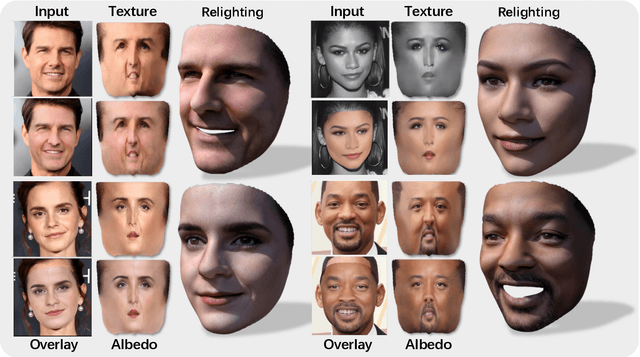

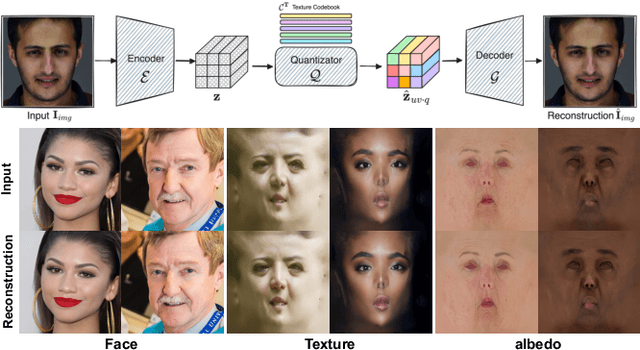

Recent 3D face reconstruction methods have made significant progress in shape estimation, but high-fidelity facial albedo reconstruction remains challenging. Existing methods depend on expensive light-stage captured data to learn facial albedo maps. However, a lack of diversity in subjects limits their ability to recover high-fidelity results. In this paper, we present a novel facial albedo reconstruction model, HiFiAlbedo, which recovers the albedo map directly from a single image without the need for captured albedo data. Our key insight is that the albedo map is the illumination invariant texture map, which enables us to use inexpensive texture data to derive an albedo estimation by eliminating illumination. To achieve this, we first collect large-scale ultra-high-resolution facial images and train a high-fidelity facial texture codebook. By using the FFHQ dataset and limited UV textures, we then fine-tune the encoder for texture reconstruction from the input image with adversarial supervision in both image and UV space. Finally, we train a cross-attention module and utilize group identity loss to learn the adaptation from facial texture to the albedo domain. Extensive experimentation has demonstrated that our method exhibits excellent generalizability and is capable of achieving high-fidelity results for in-the-wild facial albedo recovery. Our code, pre-trained weights, and training data will be made publicly available at https://hifialbedo.github.io/.